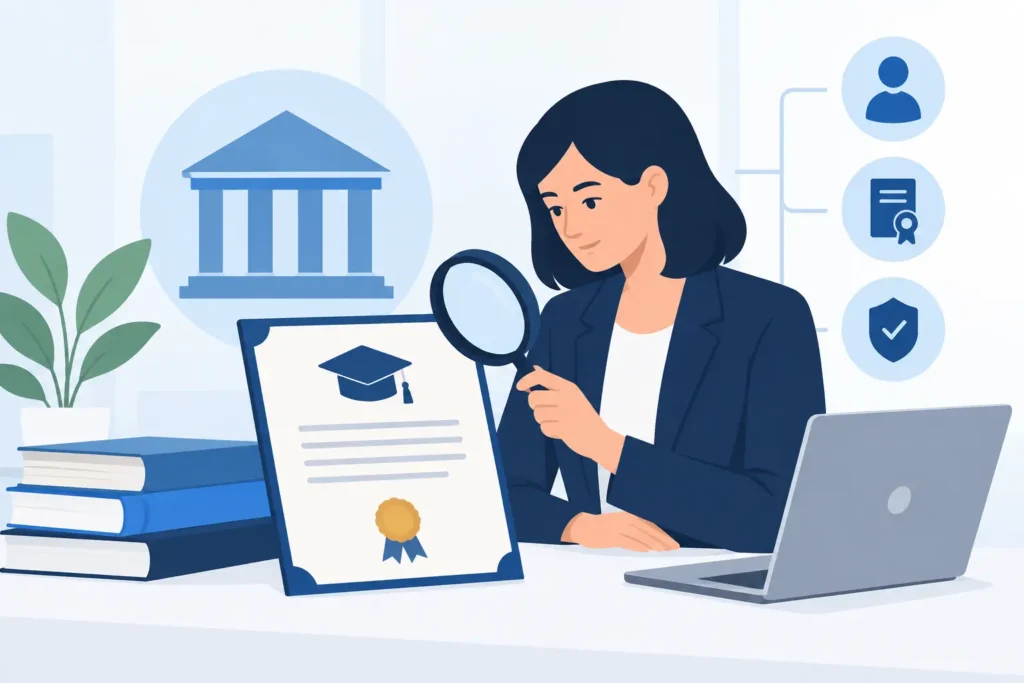
A CV can open the door, but a qualification claim may be checked before an offer becomes final. Degree verification services give employers, universities and professional bodies a way to confirm whether an award was genuinely issued, by whom, and at what level. For applicants, the priority is equally clear: make sure the information attached to your name is accurate, consistent and supported by records from the real awarding institution.
That matters most when a career move, promotion, regulated role, visa application or further-study place depends on your education history. A missing certificate is frustrating. An unclear transcript can delay a decision. But speed should never replace legitimacy. The safest route is always one that can be confirmed directly through the university or an authorised verification channel.
What degree verification services actually confirm
Verification is not simply a visual inspection of a certificate. Employers know that a document can look convincing while containing incorrect details. A proper check normally compares the information supplied by the applicant with institutional records.
Depending on the request and the applicant’s consent, the check may confirm the graduate’s full name, the institution, course title, qualification level, classification or grade, dates of attendance and award date. It may also identify whether the institution was recognised and authorised to award that qualification at the relevant time.
The scope depends on the employer. A recruiter hiring for a non-regulated role may only need confirmation that a bachelor’s degree was awarded. A university admissions office may require a full transcript, module results and evidence of the awarding body’s status. Regulated employers, including organisations in health, finance, education or public service, may apply more detailed checks.
A genuine verification result does not mean an employer must hire someone. It confirms factual education information. Employers still assess experience, references, right-to-work status, skills and suitability for the role.
Why employers verify qualifications
For many employers, qualification checks are a routine part of responsible recruitment. They help protect the organisation, its clients and other employees from inaccurate claims. This is particularly relevant where a role requires specialist knowledge, registration or a specified degree.
There is another practical reason: titles can be confusing. Similar course names, international grading systems and changes in university names can make it difficult for a recruiter to judge a credential from a scan alone. Verification replaces guesswork with an official answer.
Applicants should not see a check as an accusation. If your details are correct, verification can remove doubt and help a hiring process move forward. The problem arises when dates, names or award details do not match. Even an innocent discrepancy, such as using a former surname without explanation, can create avoidable delays.
The safe route for lost certificates and transcripts
Lost, damaged or stolen documents are common. Moving house, travelling, flooding, fire and years of storage can all leave graduates without the original certificate they need. The answer is not to purchase a replacement from an unrelated third party claiming it can produce a registered qualification. Only the original awarding institution, or an officially authorised records provider, can issue a legitimate replacement or confirm an academic record.
Start with the university registry, student records office or alumni team. Be prepared to provide your name while studying, date of birth, student number if available, course details and approximate graduation year. If the institution has merged, changed name or closed, its records may have been transferred to a successor body, archive or designated records service.
A replacement certificate is not always identical to the original. Universities may use current templates, signatures or security features. That does not make it less valid. What matters is that it comes through the authorised channel and can be supported by the institution’s records.
Transcripts deserve the same care. An official transcript usually shows courses or modules, results, credit values and the final award. It is often more useful than a certificate when applying for postgraduate study, professional recognition or roles requiring particular subjects.
How verification usually works
The process often begins when an employer asks an applicant to provide consent and details of their education. The employer may contact the university directly, use an authorised screening provider, or request that the applicant obtains official documentation through an approved digital or postal process.
For UK qualifications, some institutions use established higher-education verification arrangements. International checks can take longer because record systems, privacy rules and response times vary by country. A qualification from Australia, the USA, Canada or Europe may be fully legitimate, but the employer may need additional time to verify the awarding institution and the record.
Expect a legitimate process to ask for clear identity information and consent. Be cautious if someone promises instant confirmation without checking records, says they can add qualifications to a university database, or offers to create a certificate for a degree you did not earn. Those claims expose applicants and employers to serious risk.
Make your application easy to verify
Small details make a major difference. Use the exact name shown on your academic record, or explain any change of name upfront. State the correct university name rather than a campus, training provider or marketing brand if that is not the legal awarding body. Include accurate dates and the full qualification title.
If you studied through a college or online provider, check who actually awarded the degree. Teaching delivery and degree-awarding authority are not always the same. A programme may be delivered by one organisation while the final award is issued by another university. Your CV should reflect that relationship honestly.
Keep a secure file containing a scan of your certificate, official transcript, award letter and any confirmation of name changes. These documents should be stored privately, not posted publicly or sent to unverified contacts. When an employer requests evidence, ask how it will be handled, who will receive it and whether consent is required.
Do not alter grades, dates, logos or wording to make a document look neater. A mismatch can be detected during verification, and an explanation becomes far harder once a record appears to have been changed.
Recognised study, equivalency and international awards
Verification and evaluation are related but different. Verification confirms that a qualification exists and was awarded. Evaluation considers what an overseas qualification is comparable to within another country’s education system. An employer may need one, the other or both.
For example, a verified overseas master’s degree may still need an equivalency assessment for a regulated profession or a university admission decision. That is not a judgement on the graduate. It is a way to compare levels, credits and entry requirements across different systems.
Before enrolling in any course advertised as online, accelerated or flexible, check the awarding institution carefully. Look for a real university presence, clear course information, admissions requirements, learning outcomes, assessment methods and official contact details. Confirm that the provider is authorised to deliver the programme and that the awarding university can verify graduates through normal records procedures.
Convenience is valuable, especially for working adults. However, an authentic academic qualification requires enrolment, learning and assessment under the rules of the awarding institution. No document package can substitute for that process.
When a verification result shows an error
Errors do happen. A misspelt name, incorrect date of birth or missing middle name can cause a verification response to fail. If this happens, contact the university’s records team rather than arguing with the recruiter. Ask what evidence is needed to correct or clarify the record, and keep the employer informed of realistic timescales.
If your institution cannot locate the record immediately, provide any supporting information you have, such as your student number, old email address, graduation correspondence or transcript. Be factual and patient. A transparent explanation is far more effective than trying to fill a gap with unofficial paperwork.
Your qualifications should support your next step, not become a source of uncertainty. Keep your records accurate, use authorised replacement channels, and give employers information they can verify with confidence.