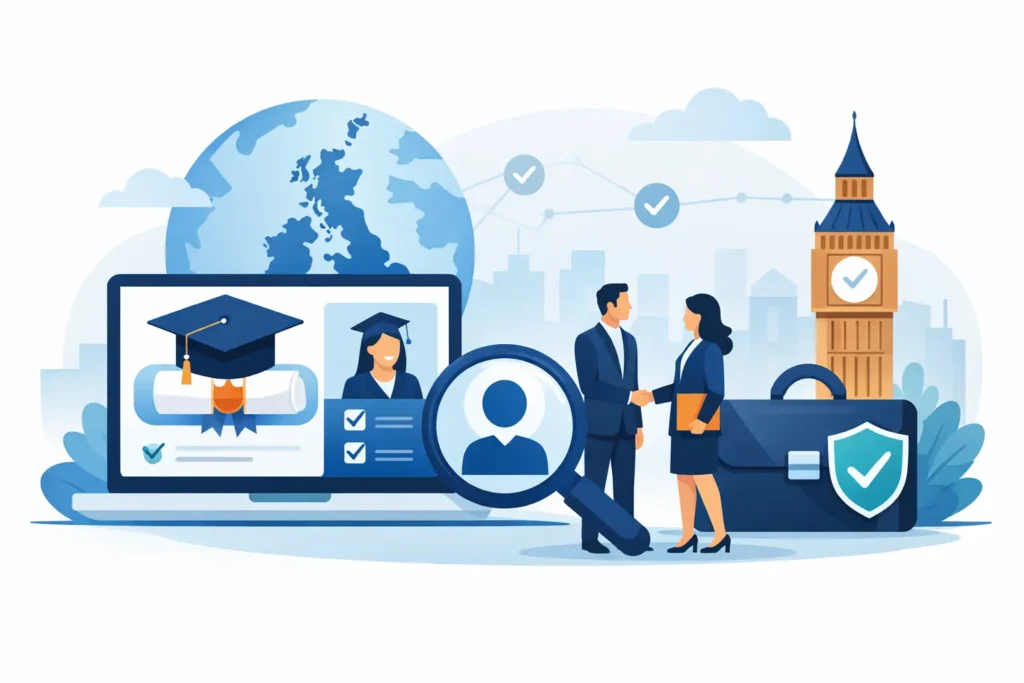
A recruiter may spend less than a minute on your CV before deciding whether to take the next step. If your qualification is listed as online or distance learning, the question is straightforward: are online degrees employer recognised? For a legitimate qualification awarded by a recognised university, the answer is usually yes. What matters is who awarded it, whether the course was properly delivered and assessed, and whether your claim can be verified.
The word “online” is not automatically a warning sign to employers. Distance learning has become a normal route for working adults, parents, career changers and international learners. However, it is not a shortcut around academic standards. Employers expect the same clarity, honesty and evidence they would expect from any other qualification.
Are online degrees employer recognised by UK recruiters?
Most UK employers focus first on the awarding institution, not on whether lectures happened in a classroom. A degree from a recognised UK university normally carries the same academic standing whether it was completed on campus, through blended learning or fully online, provided the university awards the qualification and applies its usual assessment requirements.
This distinction matters. A university may offer an online programme directly, or it may work with a learning partner while retaining responsibility for admissions, assessment and awarding. In either case, the qualification should clearly identify the university that awarded it. The employer needs to be able to confirm that institution, the award level, the dates attended and the result.
Some employers will not ask how you studied at all. Others may ask during an interview, especially if the role involves self-management, remote collaboration or specialist knowledge. That can be an advantage. Completing a properly structured online programme can demonstrate discipline, organisation and the ability to meet deadlines alongside work or family commitments.
Recognition is not the same as automatic suitability. A degree may be recognised while a particular vacancy still requires a certain subject, grade, professional registration or number of years of experience. For example, an online business degree may support an application for a management role, but it does not replace regulated training required for medicine, teaching, law, engineering or clinical practice.
What employers actually check
Recruitment checks vary by employer and seniority. A small business may simply review your CV and interview performance. A large employer, public-sector body, regulated organisation or international company may carry out a formal education check before confirming an offer.
They commonly verify the awarding university, the name of the qualification, your classification or final result, and the dates of study. They may contact the university directly or use an approved verification service. In the UK, employers can also use recognised higher-education verification routes where appropriate. For international qualifications, they may request an assessment that explains how the award compares with UK education levels.
The key point is simple: a genuine qualification must be verifiable through the awarding institution’s official records. A convincing-looking certificate, transcript, QR code or letter is not proof on its own. Recruiters understand that documents can be altered, copied or misrepresented, which is why direct confirmation matters.
If you have lost or damaged an original certificate, request a replacement from the university registrar, alumni office or official records team. This is the proper route to a replacement award document and transcript. Do not rely on a third party that promises a new qualification without study, assessment and a traceable university record. Presenting a qualification that was not genuinely earned can lead to a withdrawn job offer, dismissal, reputational damage and, in serious cases, legal consequences.
Recognition starts with the awarding body
Before committing money or time to online study, identify exactly who awards the degree. Marketing language can be persuasive, but the course page should make the answer plain. You should be able to find the university’s official name, the qualification title, entry requirements, programme length, assessment method and student support arrangements.
For UK degrees, check that the institution has recognised degree-awarding powers and that the award appears within its own official course information. If a provider says it is “accredited”, ask by whom and for what purpose. Academic recognition, professional accreditation and membership of an industry association are not interchangeable.
Professional accreditation deserves particular care. A business or computing degree may be widely accepted by employers without additional accreditation. In contrast, a programme intended to lead towards chartered status, licence eligibility or professional registration may need approval from a named regulator or professional body. If your career goal is specific, check the requirement before you enrol, not after graduation.
International applicants should take an equally careful approach. Employers in the UK may recognise degrees from universities outside the UK, but they may need help understanding the level and status of the award. Keep official transcripts, module descriptions and confirmation letters available. Where an employer requests a credential evaluation, use the route they specify and give yourself enough time for the process.
Signs of a credible online programme
A legitimate online degree is transparent about how learning works. You should expect clear modules, named learning outcomes, academic staff information, assessment rules, academic integrity requirements and a student complaints process. There should also be a defined way to contact the university for enrolment records, results and replacement documents.
Be cautious if a provider guarantees a degree in days, offers to create transcripts for education you did not complete, or says no coursework, examinations, projects or assessment are required. Genuine universities may offer flexible pacing and recognise prior learning in limited, documented circumstances. They do not award a bachelor’s degree, master’s degree, MBA, PhD or DBA merely because somebody needs a credential quickly.
Speed can be useful when you need an official duplicate after a document has been lost, or when you need a university to send verified records to an employer. But speed should never replace the underlying academic record. The record must already exist and be held by the institution that awarded it.
How to present an online degree with confidence
Your CV does not need to apologise for distance learning. List the degree as you would any other qualification: award title, university, graduation year and classification where relevant. Only add “online”, “distance learning” or “part-time” when it gives useful context or the application asks for the mode of study.
Use the space around the qualification to show its value. Mention a relevant dissertation, capstone project, specialist modules or measurable work completed during the course. If you studied while employed, that can reinforce your ability to balance priorities, but keep the explanation concise and relevant to the role.
At interview, answer questions directly. Explain why the programme suited your circumstances, how assessment was completed and what you learned that applies to the job. Avoid exaggerating university rankings, professional approvals or attendance arrangements. A clear, accurate answer builds more trust than an elaborate defence.
For roles with formal screening, prepare early. Keep digital copies of your official certificate and transcript, but remember that an employer may still seek confirmation from the university. Make sure your name, date of birth and previous names are consistent across your application and university records. Small discrepancies can slow down a legitimate check.
When an employer may be more cautious
Certain sectors apply higher scrutiny because the consequences of an unverified qualification are greater. Financial services, government, healthcare, education, aviation, legal services and regulated engineering roles may check both the degree and any related registration. Senior appointments can also involve deeper screening, particularly where the role includes responsibility for public funds, safety or compliance.
That is not discrimination against online learning. It is a check that the qualification meets the role’s stated standard. If an employer appears uncertain about your degree, provide the university’s official award information and offer permission for them to verify it. Do not attempt to solve the issue with unofficial paperwork or claims that cannot be independently confirmed.
A recognised online degree can be a practical route to career progression, but it earns employer confidence in the same way as any credible qualification: through genuine study, transparent awarding and records that stand up to scrutiny. Choose the programme carefully, keep your official documents safe, and let a straightforward verification process support the work you have actually done.
Pingback: Qualification Fraud: Protect Your Career and Future – Buy a Degree Onlineg
Pingback: Academic Accreditation: How to Check a Degree – Buy a Degree Onlineg