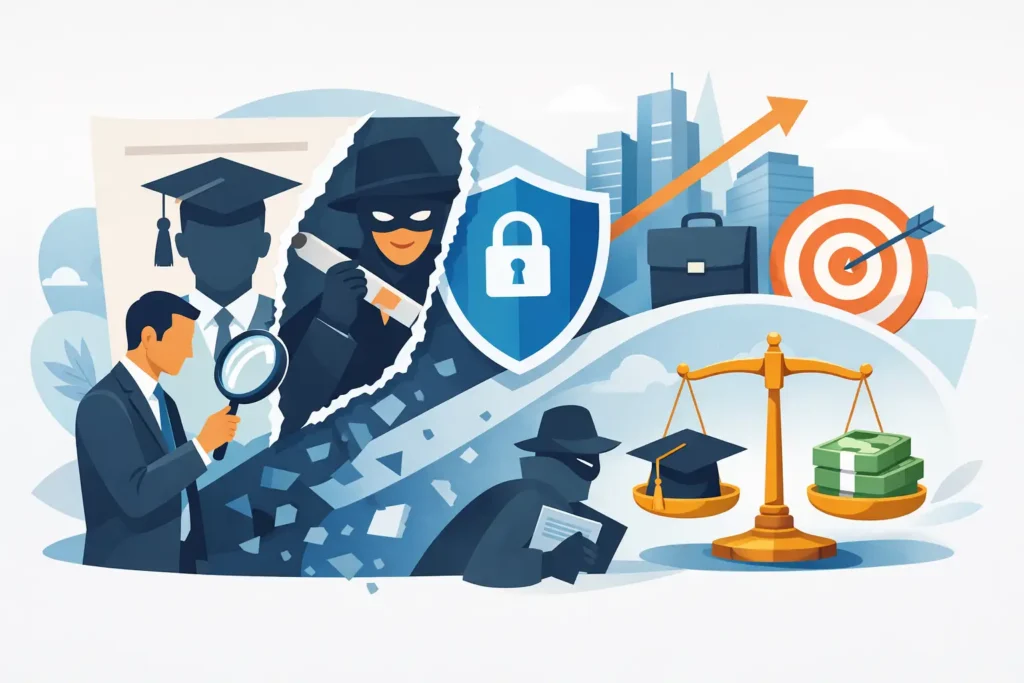
A missing certificate can feel urgent when a recruiter wants proof of your degree by Friday. But qualification fraud is not a shortcut around an awkward paperwork problem. It can put a job offer, professional registration, visa application and long-term reputation at risk.
For professionals under pressure, the distinction matters. Replacing a qualification you genuinely earned is legitimate when done through the awarding university or its authorised records service. Presenting a document for a qualification you did not complete, altering results, or claiming an institution awarded something it did not is deception. The consequences can extend far beyond one application.
What qualification fraud actually means
Qualification fraud occurs when someone misrepresents their education, academic award, grades, attendance, institution or professional training. It is not limited to a counterfeit degree certificate. A CV that lists an unfinished course as a completed degree, a transcript with changed marks, or a reference that confirms study never undertaken can all create serious problems.
Some cases are deliberate. Others begin with poor advice, a misunderstanding about course status, or a rushed decision made during a difficult career transition. The result is still the same if an employer, university, regulator or immigration authority relies on false information.
A genuine academic qualification is more than a printed certificate. It is an award supported by enrolment records, assessment history, academic regulations and an institution authorised to confer that award. A QR code, embossed seal, high-quality paper or professional-looking transcript does not turn an unearned document into a valid qualification.
Replacement documents are different
If your original degree, diploma or transcript has been lost, damaged or destroyed, you do not need to take risks. Contact the university that issued the award and request a replacement certificate, certified copy, transcript or confirmation letter. Universities normally retain records of awards and can explain their process, identity checks, fees and expected timescales.
If the provider has merged, closed or changed name, records may have transferred to a successor institution, an awarding body or an official archive. Start with the institution’s published student records contact point. Keep copies of your identity documents, previous student number, graduation year and any correspondence that helps locate your record.
Why employers take qualification fraud seriously
Recruitment teams are not only checking whether a candidate has an attractive CV. They are managing legal, operational and reputational risk. This is particularly strict in regulated, safety-critical and public-facing roles, including healthcare, education, engineering, finance, law and public service.
An employer may verify the awarding institution, qualification title, classification, graduation date and attendance status. For certain jobs, they may also need confirmation that an applicant holds a current professional licence or has completed specific accredited training. A discrepancy does not always prove dishonesty, but it will usually prompt further questions.
The consequences depend on the role, the information given and the organisation’s policies. An offer may be withdrawn before employment starts. Existing employees can face disciplinary action, dismissal for gross misconduct or referral to a regulator. Where false documents are used to obtain money, immigration status, regulated work or public funding, the matter can become more serious.
There is also a practical cost. Once trust is damaged, correcting the record takes time. Recruiters may be willing to discuss a career gap, a change of direction or an incomplete course. They are far less likely to overlook an inaccurate qualification claim.
How to verify a qualification safely
Verification should be transparent and based on the awarding institution’s records. If you are an employer, obtain the candidate’s permission where required and use the university’s recognised verification route. If you are a candidate, ask what information will be checked and make sure your CV matches your official documents.
Be cautious of services that focus mainly on fast delivery, secrecy or claims that a document will pass every background check. A legitimate replacement process should be able to explain who awarded the qualification, how records are held and how an employer can independently confirm it. Vague assurances are not the same as evidence.
There are several warning signs worth treating seriously:
- The provider promises a degree without study, assessment or a recognised prior-learning process.
- The institution cannot clearly identify its legal name, awarding powers or physical contact details.
- You are encouraged to use a different graduation date, classification or course title from the one recorded by the university.
- Payment is requested before basic questions about eligibility, identity or previous study are addressed.
- The seller claims verification is guaranteed but cannot explain how the awarding institution will confirm the record directly.
No single sign gives the whole picture. Some legitimate distance-learning programmes are flexible and may offer recognition of prior learning. However, they still have admissions requirements, learning outcomes, assessment rules, named academic staff and a clear process for awarding credit. Flexibility is not the same as bypassing education.
Protecting your CV when your studies were incomplete
Many job seekers worry that honesty will weaken their application. Usually, clear wording is safer and more persuasive than an inflated claim. If you started a degree but did not graduate, state the subject, institution and dates attended without using a degree title you did not receive. If you completed modules or earned a recognised certificate, name the actual award.
Where experience is your strongest asset, put it first. Explain the skills you developed through work, professional training, volunteering or independent projects. A hiring manager may value proven performance more than a qualification that is unrelated to the role.
If a role genuinely requires a degree or professional credential, consider realistic routes to meet that requirement. Part-time study, distance learning from a recognised provider, credit transfer, apprenticeships, conversion courses and employer-supported training may take longer than a quick document purchase, but they create a record you can confidently stand behind.
Handle mistakes early
If you have already submitted incorrect qualification information, correct it promptly. Contact the recruiter or employer, explain the error plainly and provide accurate documents. This may be uncomfortable, but it is safer than waiting for a formal check to expose the issue.
Do not try to repair one inaccurate claim with another document. Keep communications factual. Save copies of corrected CVs, application forms and correspondence, especially if several recruitment agencies or employers have received earlier versions.
A safer route when you need proof quickly
Urgency is common. A new role, promotion, professional body application or overseas opportunity may require evidence at short notice. Begin with the awarding university and ask whether it can issue a digital transcript, electronic award confirmation or secure verification directly to the requesting organisation. In many cases, this is faster and more credible than waiting for a printed replacement.
Tell the employer you have requested official confirmation and provide a realistic date. Most responsible organisations understand that historic records can take time, especially for older awards. What matters is that your explanation matches the evidence and that you use the proper channel.
For international qualifications, allow extra time for translation, credential evaluation or verification across borders. Names of institutions can change, grading systems vary and records may be held differently. Accuracy is worth more than an overconfident claim.
Your career should not depend on whether a document looks convincing for one afternoon. Use qualifications you have earned, obtain replacements from the real awarding body, and be direct about what your experience represents. That approach may feel slower under pressure, but it protects the opportunity you are working towards.